Four part video series... mortar aggregates extraordinaire...
Wednesday, August 4, 2010


Tuesday, May 4, 2010
Of Hearth & Home
Newburyport Preservation Trust, September 16, 2008, Newburyport, MA
A lecture and slide presentation by a traditional trades brick mason "Dick the Bricky" with a lot of New England early fireplace and architecture information.
A lecture and slide presentation by a traditional trades brick mason "Dick the Bricky" with a lot of New England early fireplace and architecture information.
Friday, April 9, 2010
Stanford White Library Fireplace
This fireplace resides within a Stanford White designed library interior at the former Lamb's Club on West 44th Street in New York City, currently The Chatwal, a boutique hotel. It is the larger of two fireplaces that we worked on at this project location.
As a subcontractor to Traditional Line Architectural Restoration, we documented and deconstructed the fireplace in 2007. At that time the bricks were crated and put in storage. In 2010 we reconstructed the masonry of the fireplace. All woodwork reconstruction is by Traditional Line. The historic reconstruction of the library, including the masonry, was subject to approval of the NY Landmarks Preservation Commission staff as well as the review of Li/Saltzman Architects.
For a detailed day-by-day photo portfolio go here.
After and Before


Monday, February 1, 2010
De-Construction of a Gold Paint Film
Tony Shafrazi is known for a number of items the most famous of which being his attack on Picasso’s Guernica in 1974. A lesser known incident was his commission of the artist Zadik Zadikian to cover 1,000 bricks with gold leaf at a museum in Teheran, Iran.
In an odd twist these two incidents, one of symbolic desecration and the other of faux bullion, came together when an artist (or wannabe artist) who claimed a relationship with Zadikian threw a few gallons of gold paint onto the cast iron and glass façade of Shafrazi’s then Noho (Manhattan, North of Houston) gallery. Note 1: Shafrazi has since moved his gallery to new digs in Chelsea. Note 2: Shafrazi is also known for his connection with Andy Warhol, Dennis Hopper and Keith Haring.
Through connection w/ an artist friend who moves in those circles we got the call to come and remove the gold paint from the façade. It was a hurry up job, we had to get in there before either the paint dried fully or the television news crews actually caught on to the affair. The task was not quite as simple or straight forward as most graffiti removal gigs as the “artiste” who seemed to want as much happening as possible for his protest was present for the full duration of the deconstruction of his vandalism... I mean, excuse me, his work of ART.
We can only surmise how much he had practiced the dance-arc of throw of paint prior to the execution in a sort of Jackson Pollack enthusiasm. The canvas in this case being vertical and a somewhat permanent attachment to the street environment within a soon-to-be Historic District.
When I say the artiste was present for the de-construction I mean in the sense that across the quaint cobble street he parked his 1970s era convertible Cadillac that was painted in leopard colors (the hand-applied paint technique on the car was sophomoric and of little intrinsic expression) with all sorts of zoo-like fluffery on the interior and he proceeded each day to dance around in leopard skin tights, his hair cut like a razorback and bleached gold-blond, with a clunky camcorder on his lithe shoulder while he video-taped the process of the work. This was before YouTube and before cell phones with video cameras and I can only rely on the vision of my faltered memory.
The small crew, there are only so many mechanics that can be fit to work across the width of the usual cast iron façade of 20-25 feet, very little aware of their role in an ‘art happening’ -- or even aware of what an art happening is -- went diligently to work with paint stripper, water blast machines (noisy) and decked in full rain gear, boldly-yellow -- pants, coats and hoods. The artiste made his noise on the street, danced around and recorded the deconstruction event. He was lucky he did not get dragged into a back alley and clobbered a few times.
I am reminded of the incident this morning because tenants in the building on the upper floors participated by throwing small flower pots off of their fire escapes. Nobody was hurt in the process, as I remember, but the crew certainly did complain. They did not complain about the crazy man dancing around on the street, whom they mostly found mildly amusing, but they were concerned that they not get hit in the head. I shared their concern for personal safety.
I am reminded of the flower pots as I contemplate a possible future gig where we worry that monkeys may throw bananas at us as we work below them. If monkeys can type out Shakespeare then I am certain that they can mimic post-modern art.
In an odd twist these two incidents, one of symbolic desecration and the other of faux bullion, came together when an artist (or wannabe artist) who claimed a relationship with Zadikian threw a few gallons of gold paint onto the cast iron and glass façade of Shafrazi’s then Noho (Manhattan, North of Houston) gallery. Note 1: Shafrazi has since moved his gallery to new digs in Chelsea. Note 2: Shafrazi is also known for his connection with Andy Warhol, Dennis Hopper and Keith Haring.
Through connection w/ an artist friend who moves in those circles we got the call to come and remove the gold paint from the façade. It was a hurry up job, we had to get in there before either the paint dried fully or the television news crews actually caught on to the affair. The task was not quite as simple or straight forward as most graffiti removal gigs as the “artiste” who seemed to want as much happening as possible for his protest was present for the full duration of the deconstruction of his vandalism... I mean, excuse me, his work of ART.
We can only surmise how much he had practiced the dance-arc of throw of paint prior to the execution in a sort of Jackson Pollack enthusiasm. The canvas in this case being vertical and a somewhat permanent attachment to the street environment within a soon-to-be Historic District.
When I say the artiste was present for the de-construction I mean in the sense that across the quaint cobble street he parked his 1970s era convertible Cadillac that was painted in leopard colors (the hand-applied paint technique on the car was sophomoric and of little intrinsic expression) with all sorts of zoo-like fluffery on the interior and he proceeded each day to dance around in leopard skin tights, his hair cut like a razorback and bleached gold-blond, with a clunky camcorder on his lithe shoulder while he video-taped the process of the work. This was before YouTube and before cell phones with video cameras and I can only rely on the vision of my faltered memory.
The small crew, there are only so many mechanics that can be fit to work across the width of the usual cast iron façade of 20-25 feet, very little aware of their role in an ‘art happening’ -- or even aware of what an art happening is -- went diligently to work with paint stripper, water blast machines (noisy) and decked in full rain gear, boldly-yellow -- pants, coats and hoods. The artiste made his noise on the street, danced around and recorded the deconstruction event. He was lucky he did not get dragged into a back alley and clobbered a few times.
I am reminded of the incident this morning because tenants in the building on the upper floors participated by throwing small flower pots off of their fire escapes. Nobody was hurt in the process, as I remember, but the crew certainly did complain. They did not complain about the crazy man dancing around on the street, whom they mostly found mildly amusing, but they were concerned that they not get hit in the head. I shared their concern for personal safety.
I am reminded of the flower pots as I contemplate a possible future gig where we worry that monkeys may throw bananas at us as we work below them. If monkeys can type out Shakespeare then I am certain that they can mimic post-modern art.
Thursday, January 28, 2010
The Sidewalk Lady
 The sidewalk lady started out as a potential business lead from an associate in our industry. The result was 1. that we got a pretty good story, 2. we now question any references from associates who do not investigate the leads that they pass on (we try to ask more questions before we say yes), and 3. we managed to extricate ourselves from further involvement with the sidewalk lady.
Our associate told us that the sidewalk lady had a problem with the platform of brick at the entry door on her house, her stoop as she called it. We spoke with her briefly on the phone. She asked us to visit her house and look at her problem. Though her house is on Long Island where we are located it is at a village quite a bit out of the way for any of our usual travels. We were not particularly inclined to spend several hours, let alone the cost of gas, to go look at a problem that we had no clue what it would amount to in a paying gig. So after much effort on her part to act the ‘desperate grandmother' in need of assistance, which took several phone calls with her calling us every day, at times several times a day to beg us to visit her house – we convinced her to send us a photograph. We had to promise to return the photograph. We promised.
A few weeks later a Polaroid photo showed up. It was a really bad photo and I could not make out from it very much of anything. It showed brick. For all the fuss we had gone through I imagined this had to be the side view to a large brick structure. The address was at a relatively well-to-do area of the island best as we could tell and we imagined this must be one hell of a nice house. We were trying to visualize what the problem was that we were being presented. She had told us there were white lines. We were clueless. What white lines? We sent the photo back. With it we sent a work proposal for what it would cost for us to visit and investigate the problems. We figured that it would take at least a day between going there, talking with her, doing some probes, knocking around a few bricks or whatever and then to write up a recommendation report and a repair proposal.
Here is an excerpt from our letter: “I have looked over the photo that you have sent to us. The photo is being returned to you enclosed. You are correct that there is not much that can be seen form the photo but it does provide us with a more accurate idea of the problem that you have. Though we are not certain that we can make much of a difference it looks like what we can do is use a pneumatic carving chisel to remove the harder portion of the efflorescence and then to use an acidic cleaner and see if there is an improvement. The appearance may be less than acceptable, but it will be better than it is now, and it will avoid the need to remove and replace the brickwork.”
She did not want to pay for our time to do that investigative work. We understood. No problem. We were perfectly willing to leave it alone. She kept calling us every few days. “Please please please come visit at my house.”
Eventually we got a paying gig in New Jersey and on the way back to Long Island, even though it was at least an hour out of our way in travel time, we made arrangements to visit at her house. Over the course of the previous weeks everything seemed to have gotten worse with her masonry and it had now spread to her concrete sidewalk. She had been talking with all sorts of people about her dire situation including the Portland Cement Association, including a contractor who was writ up in the NY Times for doing shot blast on concrete parking decks.
Shot blast uses a machine that shoots steel bee-bees at the concrete and at the same time sucks them and the pulverized concrete back up again. It is used to remove the top surface of concrete in order to roughen up in preparation for a surface bonded coating... it is a fairly standard process with large parking garages. The equipment is expensive, the crews need to be experienced, and the money is made in getting in, doing large areas quickly, and then moving out. It is paid for by the square foot of area blasted. Quite often it is done in an operating garage with the need to deal with the hassles of vehicles... but not always the need to deal with grandmother types.
It was getting toward evening and we were tired from a day of work. What we really wanted was to get home after a few days away. We also wanted to get her to stop calling us. We found ourselves slightly lost in a suburban neighborhood. Not as upscale as we had imagined, but not terribly shabby either. We finally found the address and our first impression was that the house, with wood siding, looked as if it was last painted in the early 1950s. Our other impression was that there must not be anyone home, even though we had called, and been called, several times to confirm the appointment. We parked. We went up to a door where there was a light on outside, not exactly sure we had the correct information. No, this was it, she answered the door. Through the screen we asked her where the stoop was at that she had the problem with. Mind you, we consciously did not want to be invited inside.
She said, “You are standing on it.”
I looked down at my feet and instead of a magnificent, even a modestly apportioned stoop what I found was about twenty brick laid flat for about nine square feet of area, I mean it was flat 3’ x 3’ in size., smaller than a kitchen table. The brick was trim around the outside of the square with concrete in the middle. It was not the side view of anything that I had been looking at in her precious photograph.
Well, if we were not raised to try to be polite, and if it was not that we wanted to get her to stop calling every few days, we may have been smart enough to turn around and run back to the street, get in the truck and keep driving.
We could not see anything at all wrong with her brick stoop. She insisted that there was. Not only was there something wrong with her stoop but her neighbor during the winter had thrown lime and rock salt onto her sidewalk and therefore she swore that her concrete was rapidly deteriorating.
Other than normal weathering, where the stone aggregate is lightly exposed, we saw nothing to complain about with her sidewalk. Mind you, this was not a 10’ wide sidewalk in 5’ squares like in the city; it was not even 4’ wide. It was a 3’ wide sidewalk, about as small as one can get with a sidewalk other than not having one at all.
She wanted to know if we could shot blast it for her. We expressed hesitation. She went on about how that was what she read about in the NY Times and it must be the only proper way to take care of her sidewalk. She was perturbed that the shot blast guy no longer returned her phone calls.
We told her that she had some very interesting problems.
“I need to show you what my neighbor did,” she said as she pulled us out further along toward the street. “You see that?”
What?
“He did that?”
He did?
“It was not there before.”
There was a slight indentation in the surface of the concrete. I got down on my hands and knees and put my head down close and looked across the surface. It took me a few minutes, with her asking questions the whole time and my trying to be polite, before I realized that it had to a child’s bare footprint from when the concrete was first poured.
She asked me what it was. I told her a footprint. She asked, “How did my neighbor do that?”
I said, "We have no clue. We don’t know your neighbor." Though we were worried at this point that she would go over and drag out her neighbor to engage in the debate. Instead she asked what could be done for it. I looked at it and told her she may want to consider telling her friends that it is the sign of a mysterious visitor.
I told her that a story may be the best option as to put a patch on it would only make it look worse, and the patch would not last, and the half cup of mortar needed was hardly going to pay for our coffee, let alone a lunch ticket.
We eventually got her backed up to her stoop. We told her we knew a mason in the area who was looking for work (we made him real happy when we passed on the referral, and I fully intend that note of happiness in a sarcastic manner).
And as she was standing on her stoop I had this impression that nobody would ever believe this story, so I asked her if I could take her picture on her stoop in front of her door.
She perked up, stood up in a proud pose in her house coat and said, “Are you going to make me famous?”
Thursday, December 17, 2009
Google Wave for Historic Preservation Projects
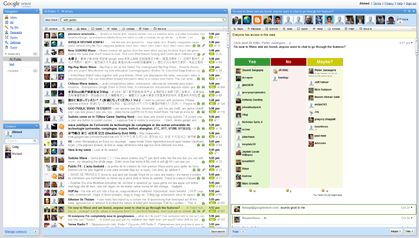 Within our small company, where our core capacity is to assist architects and structural engineers in their investigations of historic structures, we have been playing with Google Wave for more than a month now.
At first our reaction was, “What do we do now?”
It took us a while to catch on but we have increasingly been opening a Wave for every new project that goes to contract, and for every project that we have in the funnel with a hope to lead it to contract.
For the most part our projects are fairly quick. Our focus is on a rapid turn-over of 1-3 day field gigs with a combination of a long-range activity in our collaborative Business Development services that we undertake with a small number of associated partners.
Though there are a number of collaborative web based services that are available, and we have used and continue to participate in a bunch of them, we have found that Google Wave provides something that works fairly well for us. But what works for us is an asset that in itself may increase the confusion for others who want to use Google Wave – we like simple tools (screwdrivers, knives, hammers) and to build up complicated systems from scratch.
For more than twenty years I have been using my own scratch built estimating spreadsheet (begun with Lotus Symphony on an AT, but even before that on a Commodore 64, that I used to manage the cash flow of a $20M project) that as the years and the needs change I change the template and refine to suit the specific needs to estimate for all sorts of historic preservation projects.
But these complicated systems that we use are built on an aggregation of simple pieces. A drawer is a drawer regardless if you have three or four-thousand of them.
So, to have a toolbox of communication tools, as Google Wave provides, gives us the fine tuning with simple pieces that we need in order to adapt the media to the results of the desired goal of efficiently sharing of many different pieces of relatively simple information.
For collaborative work-teams on historic preservation projects it helps to be able to share and make accessible project information and files (regardless if it is room to room or country to country exchange).
Here is a list of comments on information pieces that we have assembled for our own in-house reference:
1. sharing of pdf documents
or other forms of documents that we have shared software for team members to be able to read/write/collaborate, though if we turn a written document into a pdf it is a whole lot easier to share it across platforms... and not everyone has the same document generating software, or the interest to use it
2. sharing of photographs, photographs can convey a whole lot more information in a hurry than a written document
quite often the information that a team member needs in order to take an action is information that we don't know that they need, in that case it is better to share information that we might think does not matter because we simply do not know what is important, or not
these can be photos that we take or they can be reference photos that we find online
progress photos
3. sharing of videos... same as for photos, lots and lots of information delivered in a painless manner
our original videos, store them elsewhere then connect them into a Wave (these can be project specific, or safety, training or how-to vids)
or find videos for reference online and connect them into a Wave
an engineering friend in Texas shared a video on replacement of rivets in an historic bridge and suddenly we had a more encompassing concept of what would be needed where we were being asked for a cost to extract rivets for testing on a bridge in New York
4. maps.... it helps if everyone knows where we might be going (in our case the logistic of where is the nearest clean and warm public bathroom is often a critical item in the success of a gig, or, as in one case, "Where is the water?")
satellite and 3-D views when they are convenient
how far away is it? how much will it cost to get there? Do we need a boat, a barge or a really large balloon?
5. information links
find URL links related to project sites and quickly aggregate them into a Wave where team members can use them for reference, quite often these links contain contact information that we would not otherwise think to connect with
6. cost information
entire estimate spreadsheets may not be the best use on a Wave, but small amounts of cost information can easily be shared (a short list of unit costs for a bid – information required under very short deadline by another team member who is assembling the bid package)
Google spreadsheets can be incorporated into a Wave, but we have not the incentive to move existing Excel estimate templates into the Google environment
7. convenience
having information about a specific project on a Wave makes it accessible from wherever we happen to be, it is also accessible when we have the time to make the access and not necessarily in-our-face like an e-mail that requires that we deal with it before we forget where it went
accessible from different computers, wherever we can gain access to the internet
we can access project information from a smart phone while up on a lift at a survey gig, eventually we may be able to figure out how to input information directly from the field as easily as from the office
8. contact information management
if we get in the habit to put contact information for individuals related to a project into a Wave then we all can share management of the information, I look forward to more tools along these lines
everyone on the team will know where to find it, we will avoid calling each other looking for contact information when we cannot find it
it will facilitate the 'team' to be able to move quickly when contacts need to be made in a hurry
9. team expansion
as a small group of team members becomes familiar with 'simple' uses of Google Wave then we can begin to add on, and bring up to speed additional team members (I can hardly wait until we have real-time language translation in a Google Wave)
10. project specific
Waves can be used to assemble collective information about individual projects that enables a team to work together as there are more team members with access to information pertinent to the project, and different teams associated with different projects can very quickly be assembled
11. task specific
Waves can quickly be built out from project specific Waves in order to put focus on specific task goals, once the goal is accomplished then the task specific Wave can be archived or erased, or folded back into the root wave for the project
12. scalable tools
though Google Wave at first appears to be an intimidating blank slate eventually new tools will be developed that will broaden the range of activities that collaborative project teams can engage with, the limit on tools is the human imagination and the need to solve specific problems
one example of such a tool is ongoing work on integration of collaborative real-time mind mapping (we like mind mapping for strategic planning)
another example is project related calendars, and ability to send out e-mail notifications from within a Wave, and other project management and scheduling tools
Friday, November 20, 2009
Three Syndromes for Traditional Trades
 In reading a column on problems that consultants have with their profession it occurred to me that traditional trades (and all the rest of us in histo presto) often have similar problems in our work when we are brought into projects, particularly at a late stage or to follow after someone else that has already mucked up the scene.
The consultant framed their issues as 'syndromes.' I assume this to mean situations that are encountered on a frequent basis and often enough to be noticeably a problem.
1. The first syndrome is coming in after someone else who didn’t do a good job.
In my book when we get to the jobsite we call this 'sloppy seconds'. There is nothing quite like when we show up at a project and find out that the previous contractor did a half-A job then split to 'unknown destination' and left a dumpster half-full in the parking lot that nobody, but nobody wants anything to do with removal from the site (been there done that, was not happy with the follow-up visit). Or the brownstone façade that is all mucked up and requires an extraordinary amount of fuss in order to straighten it out… and the end-client does not understand why (if they were overly parsimonious to begin with that could have been a root cause of the current scenario) and they are suspicious that they get ripped off once again… and they double-up on driving the 'qualified' carpenter nutso.
In historic preservation work it is more important than in almost any other construction industry to involve traditional trades early on in the plan process, trades who often bring with them a practical hands-on knowledge as to how to go at a project, let alone that they are the ones that eventually are given over responsibility to handle and interface with the heritage materials.
Then again, there is always a profit opportunity in chaos. Do not call us until you have done a thorough job of making the best mess possible.
2. The second syndrome is walking into a situation where the politics are intrusive.
We arrive invited to look at the problem with the stucco full of obnoxious cracks and we make a polite suggestion as to what to do with it and the ivy suckers.
The client DOES NOT want to involve an architect or an architectural conservator (these days that is like a giant red flag… poor mason with a love to play with stones is not in the business to help psychotic people work through their obsessive compulsive selection processes… I learned from my grandmother to avoid this choice-oriented involvement at all possible cost… I don't really care if the couch upholstery has pheasants on it or mallards – your building may be the most beautiful one on the block but to me it is one of another building, sorry) and the next thing we know is that it is not about problems with the stucco – it is about problems between the client and their family, or their neighbors, or their illicit lover, or their shrink. Yeeish!
I once got mad at the conservancy because they did not filter referrals from property owners to first see if they were insane or not. To have enough money to own a property does not immediately register a person as normal. You may notice this as well with how people drive expensive cars.
The adage that those who know how to hammer a nail believe that all problems can be solved if they hammer a nail is a bit passé.
Nowadays when I look at a project I am not so much interested in the physical aspects of the work as my first question is, "What is the primary problem that we are going to get saddled with here if we say yes?" Oddly, increasingly, we are hired with it in mind that we will solve these 'intangible' problems with a bit of sleight of hand to include judiciously applied caulk.
3. The third syndrome is the one where people are afraid you’re going to come in and make them look bad.
Well, as it is we like our clients and associates, particularly the folks that we have working alliances with – we want them to look good. It is a right golden rule thing to do.
We have no interest to make anyone look bad… well, usually we have no interest. On occasion there comes along someone that makes it very difficult to make them look good, even to make them look half ways decent, and there are the instances where it becomes a survival expedient to make sure that they not only look as bad as possible… but that you don't get any on ya.
We have friends who will stand up and punch it out when they get to this kind of an impasse. We do not agree with them, as passionate as they may feel about the wrongness of the unfairness of the dastardliness of the… in most cases, excepting those that embody a true manifestation of vile evil (in memoriam of a particular lawyer that we don't like), our advice is to wrap it up, smile, walk away.
Life gives us a finite amount of energy between when we are born and when we will be dead. Better to spend it on a laughing adventure than on a war (or otherwise figure out how to engage really good lawyers on your side and then laugh, but not too soon -- we know at least one kool nifty super spiffy lawyer to recommend).
Think about when you have encountered these syndromes in your dealings with project teams at historic sites. How did you feel about it? How did you react? Do you have any tips on best practice? If you are in the traditional trades do you think about these intangible issues with a project before you put your work proposal together? If you need help and you are not too terribly messed up in the head then call us. Then again, maybe not, we have enough problems already.
Subscribe to:
Posts (Atom)

